

Sabbath Time

Place: Shelbyville, IN
Start: 08:09 PM, 04/03/2026
End: 08:10 PM, 04/04/2026
Meet the Pastor
-
10/18/2025
Is it ok for a Christian to celebrate Halloween?

Should Christians Celebrate Halloween? Should Christians really celebrate a day that promotes spiritualism? You might be wondering what Christians ought to do about Halloween. Should we close our doors, shut off our porch lights, and ignore trick-or-treaters? Or should we open our doors to children but offer them something instead of candy, perhaps a healthy treat along with Christian literature? And is it biblical to provide alternatives to Halloween parties, such as a harvest festival, at our churches?
In other words, how can a Christian be in the world and not of the world on October 31? Here are five guidelines that can help you through this yearly holiday:
- Understand the Bible truth.
God’s Word teaches that the dead are truly dead. (See, for instance, Ecclesiastes 9:5. We’ll also include a link to our Study Guide below.) Take time to teach your children that the Bible does not support the worship of the dead or any attempt to contact them. Whether the roots of Halloween come from Samhain pagan beliefs or was an attempt by the Christian church to honor dead saints, the Bible is clear that death is an enemy and is a result of sin—it’s not a rite of passage (1 Corinthians 15:26). Should Christians really celebrate a day that promotes spiritualism?
- Take the opportunity to do good.
Jesus encouraged His disciples to be “in the world” but not “of the world” (John 17:15, 16). While it’s not always easy for believers to know where to draw the line of being “all things to all people” but refusing to participate in unholy activities, many Christians take the opportunity to share their faith with neighbors on Halloween. Instead of ignoring children who happen by their homes, for instance, they open their doors and, with smiling faces, share a healthy treat and even appropriate literature to guide visitors toward Jesus. (Check out some resources here.)
- Avoid anything that promotes spiritualism as fun.
Decide in advance, based on Scripture, what activities your family will choose to participate in during Halloween. Ask for God’s help in prayer and Bible study, and then follow the convictions of the Holy Spirit with a clear conscience. However, some activities are obviously things in which a Christian should not participate. Watching horror movies, gorging on candy, playing pranks that hurt people, or visiting so-called haunted attractions are all things Christians will avoid.
Easily share the Bible truth with Afterlife Mystery.
- Offer alternatives.
Involve your local church community in creating a social event that likeminded families can enjoy—events without the implications of spiritualism. Some churches choose a theme, such as Noah and the Ark or the Reformation, and focus all their activities around lessons that combat the unbiblical ideas associated with Halloween. Even many unchurched parents will be thankful to join in a positive, safe social experience that avoids frightening their children. And opening your doors to them is an opportunity to teach them about your church.
You can also invite families into your home for a short, age-appropriate Bible study, refreshments, and family-building games. Make it a time of worship and fellowship with the emphasis that Jesus taught us to “hallow” the name of our heavenly Father (Matthew 6:9).
- But whatever you do, follow Christ’s example.
The Bible says it is not our place to judge others. “Do not speak evil of one another, brethren. He who speaks evil of a brother and judges his brother, speaks evil of the law and judges the law” (James 4:11). Some fellow Christians might still be trying to work through how to deal with Halloween. Maybe they are not as clear or as convinced as you are about what to do—especially those with children. Approaching them with an angry or critical spirit will not help them see Christ.
Instead of condemning parents, realize that each person is responsible for their own choices and then trust God to guide fellow believers. Guide them with a loving spirit, pray for them, and make sure they are someone you include in your October 31 plans.
Amazing Facts:Trick, Treat, Zilch? Should A Christian Celebrate Halloween?
Lake Union Herald
Bottom left to right: Emma Oprisu, Pastor Benitez, Daniel Hernandez
Left to right: Eric Oprisu, Cassidy Oprisu, Tom Hinton, Tammy Begley, Janet Brown, Ryan Hernandez, Talia Plew, Ron Plew
Back row: Shawn Plew and Erica Hernandez
Spotlight on...

This month's spotlight is on our church blessing box.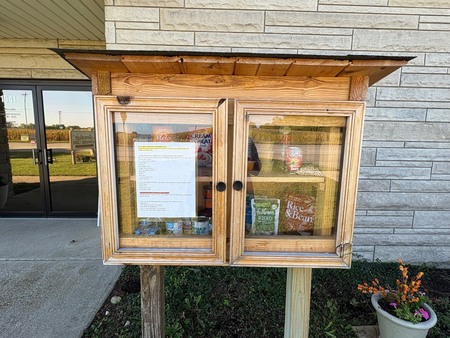
Did you know that there is a blessing box located right outside of our church front doors? It is filled with all sorts of non-perishable items, and items are constantly stocked each week. We want to share our blessings with those within the community and share God's blessings with those who need our help. We believe that we are all called to help our neighbors. “For I was hungry and you gave me
something to eat,
I was thirsty and you gave me
something to drink...
Truly, I say to you,as you did it to one of the
least of these my brothers, you did it to me.”
Matthew 25:35-40
